
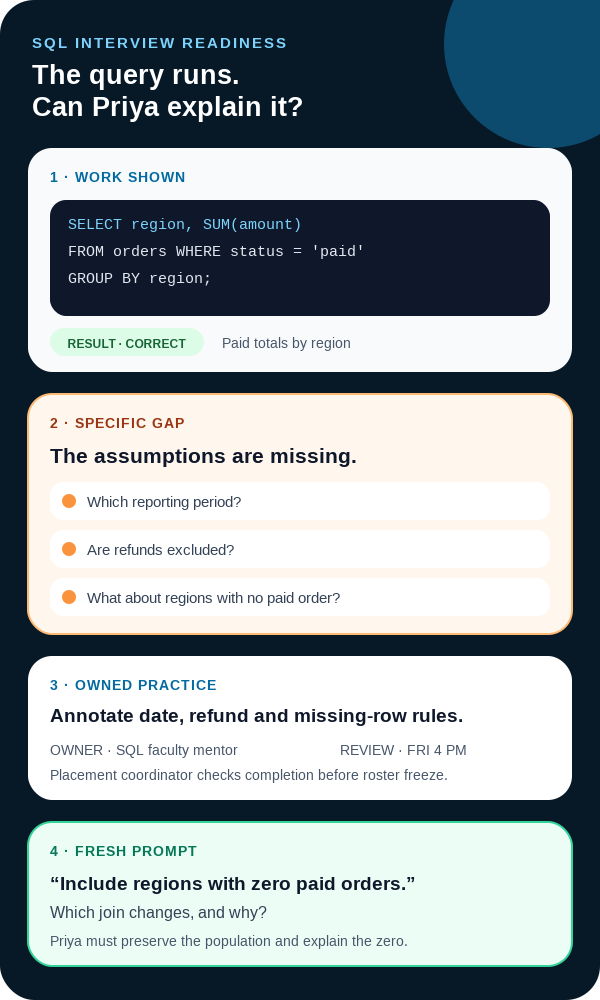
1 · Work shown
The query is correct
Priya groups paid orders by region and returns the expected totals from the supplied table.
Campus placement readiness assessment
Priya gets the SQL query right, then stalls when a mock interviewer asks what the result excludes. Her placement officer records the exact gap, assigns practice, names an owner and checks a fresh prompt before the next drive.
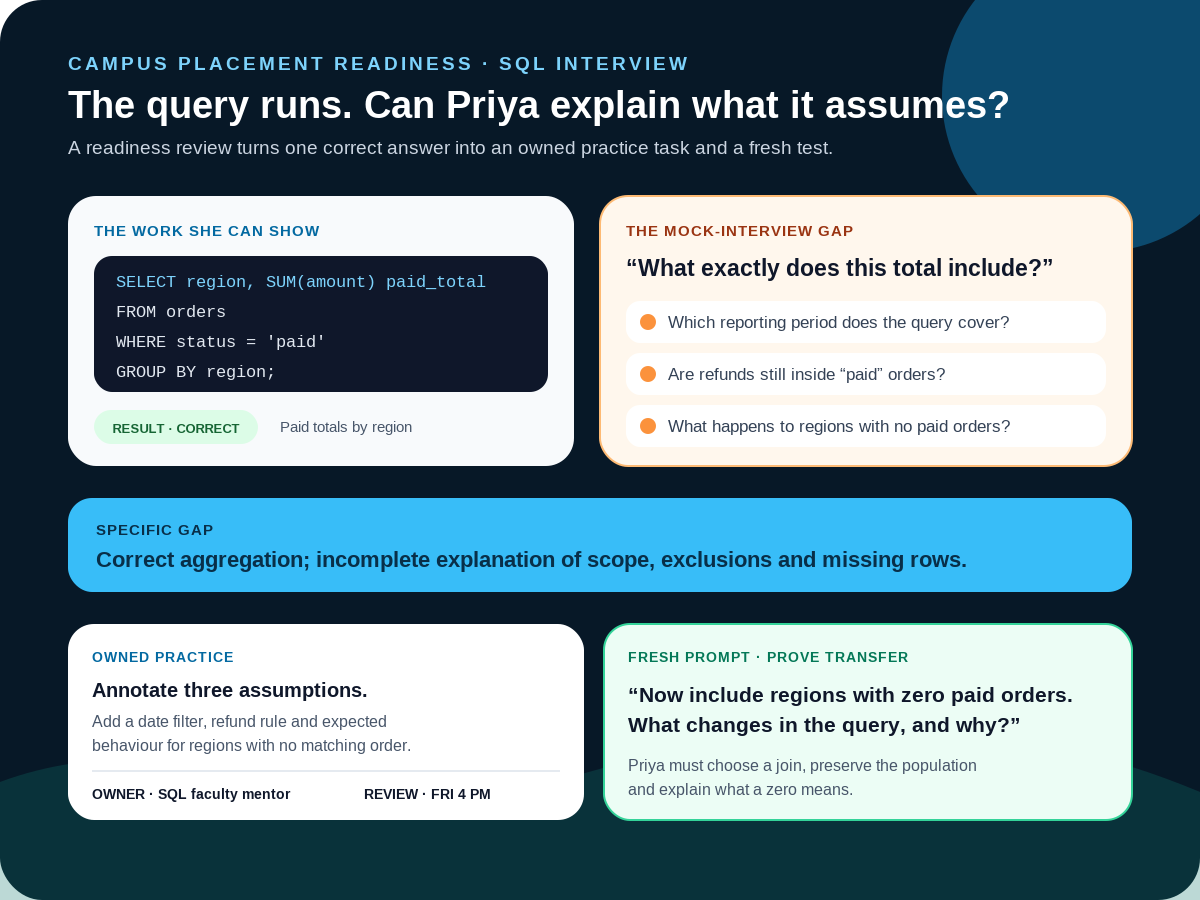
Worked student review
Keep the observation narrow enough that a student can act on it and a reviewer can check it again.
1 · Work shown
2 · Specific gap
3 · Practice
4 · Ownership
5 · Transfer
What changed
Before coaching
“The query gives the right total.”
After practice
“It totals paid orders in the stated period, excludes refunded rows and omits regions with no matching order.”
Fresh evidence
Priya changes the query for zero-order regions and explains why the population now needs a different join.
Assessment to action
A quarterly assessment is useful when the placement team can connect it to evidence, choose one development action and review new work.
For an associated student, an authorised placement team can use detailed quarterly LayersRank assessment context alongside the student's work. The officer still chooses the coaching action, owner and review date.
Do not turn one domain score into drive eligibility or a hiring verdict. Priya's SQL result supports a technical observation; her fresh explanation shows whether the coaching transferred.
| Record | Placement-cell question | Decision |
|---|---|---|
| Quarterly domain observation | Which behaviour in the student's work needs attention? | Write one specific gap, not a general label. |
| Work sample or mock answer | What can the student already demonstrate? | Keep the successful part and practise only the weak step. |
| Fresh prompt | Can the student use the idea when one condition changes? | Close, repeat or change the coaching action. |
Non-IT example
The same review method works when the evidence is an operations record rather than code.
| Step | Aditi's operations example |
|---|---|
| Work shown | Opening stock 48 + receipts 12 − issues 17 = 43 expected; physical count is 42. |
| Specific gap | She spots the one-unit variance but says only ‘check the warehouse’ without naming the record, owner or sequence. |
| Practice assignment | Check the goods receipt, bin movement and shift handover in that order; write who owns each follow-up. |
| Owner and review | Operations faculty mentor · Monday, 11 am; placement coordinator checks the completed handover note. |
| Fresh prompt | One damaged unit was recorded after the count. Which number changes, and which discrepancy still needs investigation? |
Seven-day follow-up
Use one target role family and one comparable prompt per clinic. The output is a short list of owned actions, not another attendance sheet.
| Day | Placement-cell action | Student output | Owner |
|---|---|---|---|
| 1 · Baseline | Choose the role family and run the same core prompt. | Unedited answer plus work sample. | TPO lead |
| 2 · Diagnose | Separate a missing explanation from a missing skill. | One precise gap statement. | Faculty reviewer |
| 3 · Assign | Set one practice task and a review time. | Task, owner and due date recorded. | Branch coordinator |
| 4 · Practise | Use the student's own work, not a generic script. | Two-minute explanation with assumptions. | Faculty mentor |
| 5 · Transfer | Change one condition in the prompt. | Fresh answer and decision trail. | Peer reviewer |
| 6 · Review | Close, repeat or change the action based on new evidence. | Reviewed status and next step. | Placement coordinator |
| 7 · Drive check | Confirm current employer eligibility separately. | Accurate application decision. | TPO lead |
Cohort coaching
A cohort pattern is useful when students saw a comparable prompt and reviewers used the same definition. Otherwise the apparent trend may be a review difference.
| Pattern in checked records | Cohort clinic | Evidence at the next review |
|---|---|---|
| Correct technical answers; assumptions unexplained | Role-specific ‘scope, exclusion, edge case’ clinic using each student's own project or query. | Students answer one changed-condition prompt without a script. |
| Team projects; individual contribution unclear | Ninety-second contribution drill: problem, own action, check, limitation. | Reviewer can identify the student's decision and supporting artifact. |
| Operations answers stop at ‘check the record’ | Handoff clinic: record, sequence, owner, escalation and review time. | Students produce a traceable exception note for a fresh case. |
| One branch appears weaker across every domain | First calibrate prompts and reviewers; coach only after ruling out inconsistent assessment. | Two sample records receive comparable judgments from both reviewers. |
Official assessment engine
Read how the official LayersRank website describes the assessment before you design a campus review rhythm.
Visit the official LayersRank websiteContinue the workflow