
1. Choose two role families
Start with two titles, such as backend developer and QA engineer. The fresher job paths show what to search for and what you could build for each role.
Placement preparation
Start from your target roles and current evidence. Build fundamentals, aptitude, project explanation and interview practice in a weekly loop that survives classes and exams.
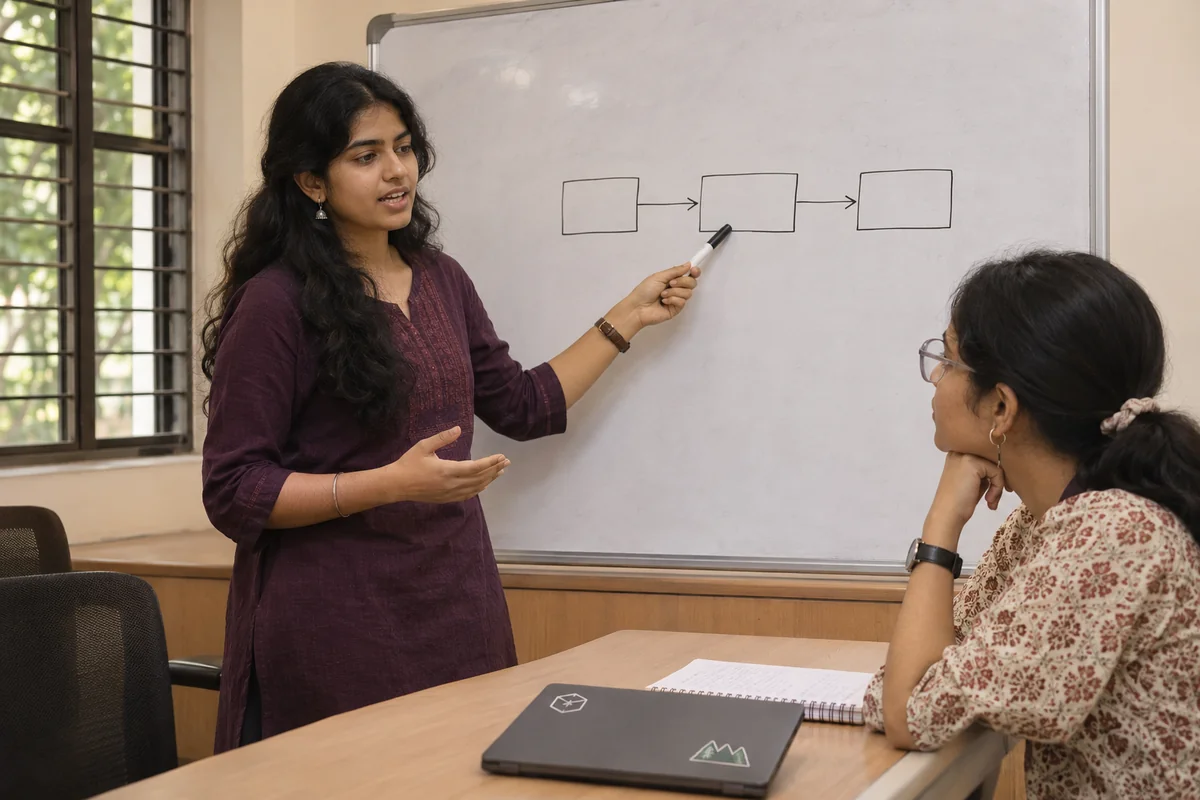
First 45 minutes
16-week roadmap
| Weeks | Main job | Student output | Checkpoint |
|---|---|---|---|
| 1–2 | Baseline and role choice | Eligibility sheet, two target role families, timed diagnostic, project evidence list. | Can you name the next likely screening stage and your current gap? |
| 3–6 | Fundamentals and aptitude | Error log, four core-topic summaries, two timed sets per week. | Accuracy first reaches 75%, then speed improves without losing it. |
| 7–10 | Project and role evidence | Five-minute project story, test table, contribution statement and role-matched résumé. | A peer can distinguish your work from the team's work. |
| 11–13 | Interview practice | Two technical mocks, two project vivas and four concise behavioural examples. | Answers use decisions, evidence and reflection instead of memorised claims. |
| 14–16 | Drive execution | Verified applications, document folder, company research notes and follow-up tracker. | You can adapt within 30 minutes when eligibility or rounds change. |
Weekly timetable
| Block | Time | What to do | Evidence to keep |
|---|---|---|---|
| Mon + Wed | 2 × 60 min | Core subject, DSA/coding or branch fundamentals for the target role. | Five solved problems plus an error note. |
| Tue + Thu | 2 × 45 min | Quantitative, logical and verbal aptitude under time. | Accuracy, time per question and error category. |
| Friday | 60 min | Project explanation, diagram and one debugging follow-up. | Updated five-minute story and test evidence. |
| Saturday | 3 hours | Mixed mock, review, résumé tailoring and one real application. | Mock breakdown, changed bullet and application entry. |
| Sunday | 60 min | Peer viva or mock interview; choose next week's limiting factor. | Three questions you could not answer clearly. |
Branch checkpoints
Worked diagnostic
| Area | Meera's result | Interpretation | Decision |
|---|---|---|---|
| Aptitude | 18/25 correct; 4 avoidable calculation errors | Accuracy is adequate, but the error pattern can cost a cutoff. | Two timed mixed sets; maintain an arithmetic error log. |
| ECE fundamentals | 6/10; weak on ADC resolution and pull-up behaviour | A likely embedded-role interview gap. | Review two concepts and explain them using her circuit. |
| Project viva | Strong build story; debugging answer jumps between steps | Evidence exists, but reasoning is hard to follow. | Practise reproduce, isolate, hypothesise, test and verify. |
| Behavioural | Uses a generic teamwork example | The answer hides her actual decision. | Prepare the failed-sensor trial as a feedback and ownership story. |
If a hard eligibility issue exists, resolve or plan around it first. Otherwise prioritise the weakest screening stage for your target role. When two gaps are equal, choose the one you can practise with observable evidence this week.
Reusable weekly plan
The CSV starts with a ten-hour week and columns for planned work, actual time, accuracy, evidence link and next action. Open it in a spreadsheet, duplicate the sample week, and reduce the hours during semester exams instead of abandoning the loop.
Download the weekly plan CSVWorked project viva
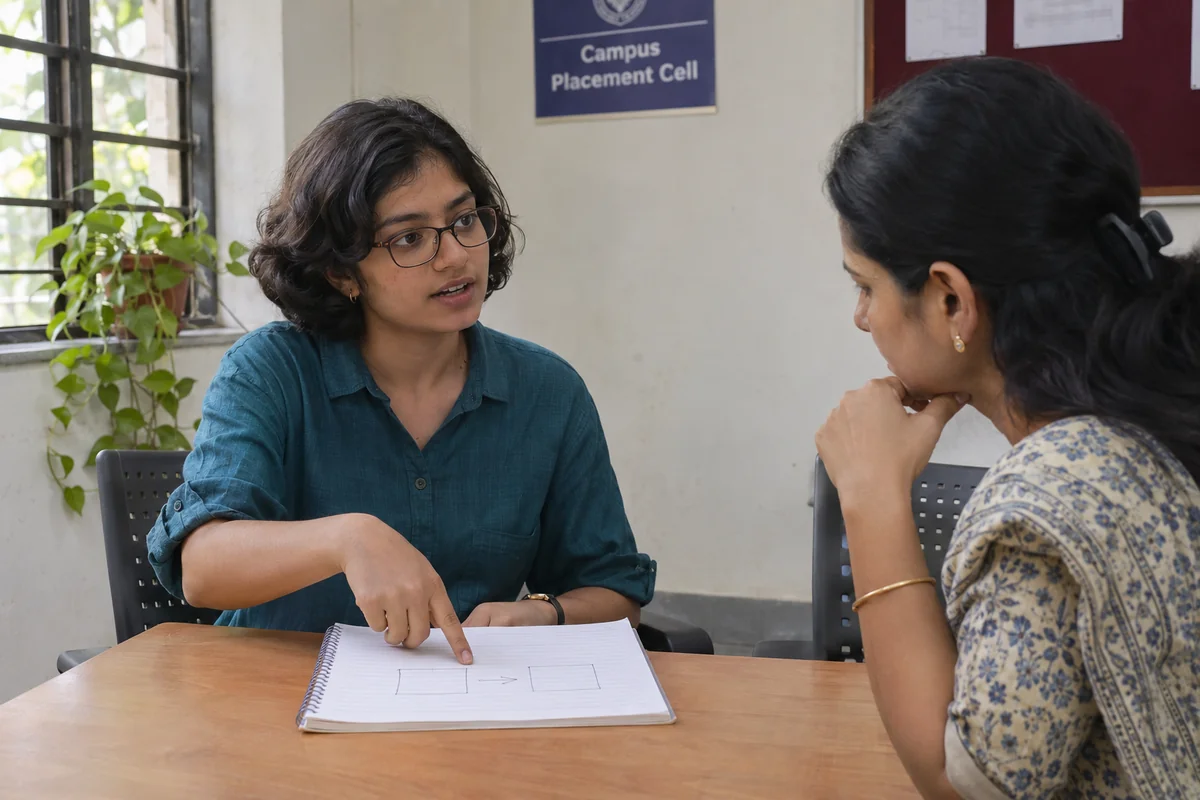
| Interviewer prompt | Useful answer move | Evidence to show |
|---|---|---|
| Why did you choose this sensor? | Name the range and interface needed, compare one alternative, then state the trade-off. | Datasheet excerpt and decision note. |
| What failed? | Reproduce the symptom, isolate likely causes, test one hypothesis, and verify the change. | Two failed readings beside the successful trials. |
| What did your teammate do? | State your boundary first, credit the peer's work, then explain the interface between both parts. | Commit, circuit, test or review record. |
| What would you change with another week? | Choose the highest-risk limitation and propose a measurable next test. | A test case with expected and observed fields. |
Behavioural answer template
Context
Decision
Evidence
Reflection
Example: when two readings became unstable before a lab demonstration, Meera paused the enclosure work, reproduced the fault across three distances, revised sampling and documented the remaining limitation. The result is useful because the decision is visible, not because the story sounds perfect.
Drive week
Connect the evidence
Use the off-campus playbook to verify postings, match eligibility and run a repeatable application process.